I have spent more hours than I care to count wandering the dark, claustrophobic corridors of Sevastopol. Each playthrough of Alien Isolation taught me something new about pressure, patience, and how the game's design changes when you strip away the interface. The recent trend toward no hud gameplay in survival horror is not just a self-imposed challenge; it is a deliberate return to a more immersive, emotionally raw way of experiencing a game. When you remove the heads-up display, you remove the buffer between you and the terror.
The Interface as a Safety Net
Most players rely on the HUD for constant feedback: health bars, ammo capacity, objective markers, and the ever-present motion tracker. These elements are helpful, certainly, but they also act as a psychological safety net. You know exactly how many bullets remain. You see the waypoint for the next save station. You can glance at the tracker and know that the Xenomorph is somewhere behind you, but not right here. That knowledge, however small, reduces the tension.
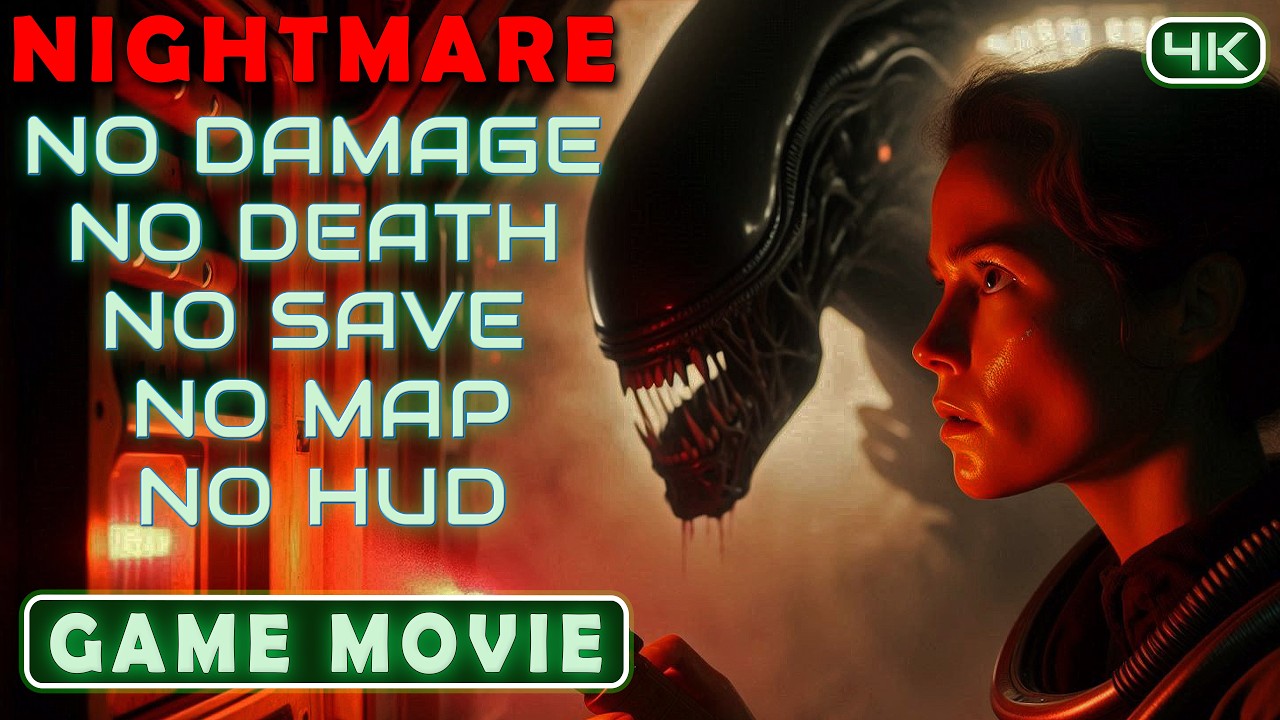
In a standard run of Alien Isolation, even on Nightmare difficulty, the HUD tells you things your character would not know. Ellen Ripley's daughter, Amanda, has no floating numbers in front of her eyes. She has a torch, a motion tracker she must physically pull out, and her own senses. No hud gameplay forces you into that same headspace. You cannot glance at a corner of the screen to confirm your health status. You have to listen to your character's breathing, watch the screen for visual cues like blood spatter, and make decisions based on incomplete information.
That uncertainty is where the real horror lives.
Relearning Sevastopol Without the Crutch
When I first attempted a no-commentary cinematic playthrough of Alien Isolation at 4K resolution, I started with the HUD on. The game is already punishing. The Xenomorph learns from your tactics. The Working Joes patrol with relentless purpose. The medical bay is a labyrinth of dead ends and ambush points. But with the HUD active, I found myself relying on it too much. I would check the motion tracker every few seconds, even when the alien was nowhere near. I would let the objective marker guide me through the ventilation ducts, ignoring the environment itself.
Turning the HUD off changed everything. Suddenly, the Sevastopol station became a real place. I had to memorise routes. I had to listen for the distinct sounds of the Xenomorph dropping from a vent, or the heavy footsteps of a Working Joe rounding a corner. The hiding mechanics became more than a button press; they became a genuine choice. Do I risk running past that doorway, or do I slide under the desk and wait? Without the HUD, those decisions carry weight. You cannot see your ammo capacity, so every shot from the revolver or the Samson feels precious. You cannot see a save icon, so you have to guess whether the last station you used is still safe.
The Cinematic Payoff
There is a reason that no hud gameplay has become a staple for content creators who aim for a cinematic playthrough. When you remove the interface, the game looks and feels like a film. The 4K resolution helps, obviously, but the real magic is in the framing. Without health bars and objective text, every shot is a clean composition. The flicker of the torch against the metal walls. The slow, deliberate pan across a room filled with cultured mushrooms in the hydroponics lab. The sudden, horrifying reveal of the Xenomorph silhouetted in a doorway.
This approach also changes how you play. In a standard run, you might sprint from cover to cover, trusting the HUD to warn you of danger. In a no HUD run, you move like a real person would through a nightmare. You walk, you listen, you stop. You check corners. You hold your breath. The pacing slows down, and that slower pace builds an almost unbearable tension. I have watched players who speed through the game on Normal difficulty struggle to survive the first hour on Nightmare difficulty with no HUD. It is a different game entirely.
Practical Lessons from the Challenge
If you are considering trying no hud gameplay for yourself, especially in a game as demanding as Alien Isolation, there are a few things to keep in mind. First, learn the layout of each major area before you commit. Spend a few runs with the HUD on, mapping out the locations of save stations, hiding spots, and key items. The medical bay, for instance, has multiple floors and a confusing layout. Without the HUD, you can easily run into a dead end while the Xenomorph is right behind you.
Second, rely on audio. The game's sound design is exceptional. The Xenomorph has a distinct clicking sound when it is in the vents. The Working Joes have a mechanical whir that changes pitch when they spot you. Your own footsteps, the hum of the station, the distant screams of other survivors; all of these are clues. In no hud gameplay, audio becomes your primary HUD.
Third, manage your resources with extreme care. Without an ammo counter, you need to keep a mental tally of how many shots you have fired. The Samson is powerful but has limited ammunition. Every bullet you waste on a distraction or a missed shot is a bullet you will not have when a Working Joe pins you down. The same goes for items like flashbangs and medkits. You cannot rely on a number to tell you what you have left; you have to remember.
The Emotional Weight of Every Decision
What struck me most about this style of play was how it reshaped my emotional experience of the story. Alien Isolation is, at its core, a game about vulnerability. Ripley is not a soldier. She is an engineer, alone and outmatched. The no HUD mode reinforces that vulnerability with every passing moment. I found myself genuinely hesitating before opening doors. I would stand in a dark corridor, torch off, listening, trying to decide if the sound I heard was the wind or the alien. That hesitation is the exact feeling the developers wanted to create.
There is a moment early in the game, right after you first encounter the Xenomorph, where you have to cross a large open area. With the HUD, you can see exactly where to go. Without it, you are just a person in a dark room, trying to remember which door leads to safety. I have died in that room more times than I can count. Each death was frustrating, but it also deepened my respect for the game's design. Every corner, every vent, every flickering light is a deliberate choice by the developers. No hud gameplay lets you see those choices clearly.
Is It for Everyone?
No. No hud gameplay is not for everyone, and that is fine. Some players enjoy the game as a tactical challenge, using the tools the game gives them. Others prefer the story-focused experience, playing on lower difficulties to see the narrative without frustration. Both approaches are valid. But for players who want to feel the full weight of survival horror, who want to experience Sevastopol as a real place rather than a series of objectives, turning off the HUD is one of the most effective ways to do it.
I have watched friends try it and give up after twenty minutes. The tension is too much. The constant fear of the unknown is exhausting. That exhaustion, though, is the game working exactly as intended. Alien Isolation is not a power fantasy. It is a survival horror game about running, hiding, and barely surviving. No hud gameplay brings that truth to the surface.
Final Thoughts on the Experience
Over the years, I have recorded several cinematic playthroughs of Alien Isolation, each one a little different. The no-commentary format lets the game speak for itself, and the 4K resolution captures every detail of the station's grimy, industrial beauty. But the decision to play with no HUD has consistently produced the most memorable sessions. The fear is real. The victories feel earned. The story hits harder because you are not just watching it; you are living it, moment to moment, without a safety net.
If you have never tried no hud gameplay, I encourage you to give it a shot. Pick a game you know well, turn off the interface, and see how it changes your perspective. You might find, as I did, that the game you thought you knew is actually something much deeper, much scarier, and much more rewarding.